|




Back home...
| |
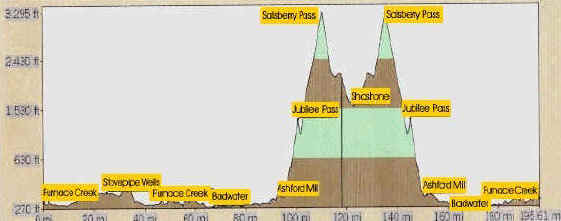
| The following chart depicts the
topographic character of the Death Valley Double. Though the actual ride consists of
two "out and back" segments, the graphic is displayed in linear form for ease of
interpretation. |
| If you're so inclined: Any reasonably well-seasoned cyclist can tell you
that the century is the initial "crucible of fire" for the road cyclist... but
for some, that's not enough. It isn't long before a comparative few begin knocking
at the door of the ultramarathon world, of which the "double" constitutes the
threshold. There are numerous challenging doubles throughout the continental United
States, but California boasts some of the most difficult and beautiful of all, many of
which can qualify their riders for a California Triple Crown -
an honor conferred for the successful completion of three designated doubles in one
calendar year.
Several of California's doubles are
excellent rides on which first-timers can cut their teeth, but Death Valley is not
one of them. The length of Death Valley's climbs, amount of total vertical gain, and
the severe elemental conditions are not generally conducive to a successful first double,
and it's recommended that new distance specialists acclimate themselves to the discipline
on a less hostile course to make certain that they're mentally, mechanically, and biomechanically
ready for the stresses that doubles impose. More information on virtually all of
California's doubles can be had from Hugh Murphy Productions. |
The Machines: |
|
Frameset |
Transmission |
Wheelset/Tires |
| Pat
Dillon |
'99 Lemond
Tourmalet/steel |
Shimano RX
100 52/42/30 crank w/13-26 cassette |
Rolf Vector
Comp/
Specialized Team Pro |
| Tom
Blumenfeld |
'97 Lemond
Tourmalet/steel |
Shimano RX
100 52/42/30 crank w/11-23 cassette |
Mavic Cosmic
Expert/
Michelin Axial Pro |
| Both
bikes were equipped specifically for unloaded long-distance, with weight being a
significant consideration. Primary and secondary headlamps were utilized, the former
being either ni-cad or cell battery-powered, with backup lamps being lightweight, AA
battery-powered units. Tail lamps were small, lightweight flashers. Gearing
featured bail-out rings in case of serious difficulty on climbs, as well as large top-end
inches for high-speed descents; in the absence of headwinds, descents out of the desert
mountains lend themselves readily to sustained speeds in excess of 50 miles per hour.
Due to the choppiness of certain portions of the course roadways, aluminum frames
are not recommended, especially for lighter riders. If you have further questions, e-mail me... if
I can't help you, I might know someone who can!
Tom |
|
|