Thulman Eastern/Chesapeake Wheelmen Colors
Fly in the California Desert: The Death Valley DoubleTom Blumenfeld
Thulman Eastern/Chesapeake Wheelmen Racing
Baltimore, Maryland
October
6th, 2000 dawned hot and dry in Las Vegas, Nevada. Although the searing sun had managed to
stare the gaudy, shameless lights of the gamblers' mecca into temporary subservience,
there was still little that could be done about the perpetual clatter of bells and buzzers
in the lobby-casino of the Westward Ho hotel as we checked out and performed a last gear
check prior to our departure from this Desert Diamond. My friend and fellow road cyclist
Pat Dillon (unattached), and I, Tom Blumenfeld (Thulman Eastern/Chesapeake Wheelmen), had
flown our machines to Vegas from Baltimore the night prior, and painstakingly assembled
them in the hotel room, which we handily converted to a tiny, temporary pit area. Saddle
heights were meticulously set and checked, wheels were examined for true, and deraileurs
were adjusted. Pedal wrenches, allen keys, and related accoutrements were strewn across
the beds like so many surgeon's implements. Any neighbors who were still awake at 1:00
A.M. might have puzzled over the shrill ratcheting of spinning rear hubs, or the alien
sigh of a floor pump exhaling repeatedly into a pair of Michelin Axial Pros. We were here
on business, and it was very serious business, indeed. We were en route to the southern
California desert to ride the Death Valley Double Century.
The Death
Valley Double, one of several back-to-back centuries among California's Triple Crown
Series, is a notoriously unforgiving ultramarathon which snakes through 200 miles of the
most heat-stricken, desolate landscape on the North American continent. Staging from
Furnace Creek, a mere angstrom of civilization in the central Death Valley National
Monument, the ride seductively whisks unwary riders 25 miles northwest, under cover of
darkness, to the miniscule settlement of Stovepipe Wells, and then back to Furnace Creek,
at an enticingly high rate of speed. There, however, the sun peels the desert's starlit
pall away from it's face and shoulders, revealing its true, skeletal features. Now,
careening southeast toward Badwater, a fetid pool of uncongenial brine which is nearly 300
feet below sea level, and the lowest point in the continental United States, riders become
singularly aware that they are not in the palm of a gentle giant, but on the back of a
kraken! By the time the cyclists execute 6- and 10-mile ascents across two consecutive
passes of the Amargosa Mountain Range, descend to the turnabout point at Shoshone,
negotiate the back side of the previous climbs, survive a blistering 16-mile descent, and
press past Badwater in total darkness on the return leg to Furnace Creek, they will have
survived 9,200 vertical feet of climb over gradients ranging from 2 to 12 percent, searing
heat, and an abject absence of shade. Death Valley's singular beauty and stark, lethal
purity constitute a fantastic paradox that is magnified exponentially when experienced
from the cockpit of a road bike. And this hostile environment has never encountered two
more willing combatants than these brazen roadies from the green, lush east.
As we
rolled onto Las Vegas Boulevard and aimed the van westward, it wasn't long before the
glistening spires of the Desert Diamond had receded into the arid haze behind us. As
impressive as the city's man-made crystalline castles initially were, their glitz seemed
faddish, temporary, even vulnerable in contrast to what lie ahead. As the density of
artificially contrived structures thinned into golden desert, virtually the only vestige
of man's presence was the ribbon of asphalt which thrust itself, like a javelin of onyx,
toward the mountains, the Guardians of the Desert. It was as if these impassive sentries,
upon our approach, had awakened and begun to heave from the desert floor to mark our
passage into their domain. The mountains, for countless eons, have exercised autocratic
charge over everything in their seemingly interminable domicile, conspiring to divert even
the insolent wind and rain at their pleasure. And as we neared Furnace Creek, the
behemoths seemed to enclose us, as if in a coliseum, establishing an adversarial tone. So
be it. We would be Gladiators, then. We would contest the Giants with trained legs and
tuned machines. We had flown 3,000 miles with our machines in tow, and would scale their
twisted, macadam spines, mount their lofty, armor-plated shoulders, and make them give us
what we came for.
|
The desert was still clad in nightgarb when Pat and I rolled our machines to the start at
4:00 A.M. on 7 October. Experienced crew wielding flashlights and clipboards bustled as
we, among approximately 70 riders, left the deck of the "carrier" Furnace Creek
and accelerated into the blackness in a silent procession of tiny, flashing tail beacons.
Most of the riders would negotiate the Death Valley Century, a mere reconnaissance mission
in contrast to the pledge which the rest of us had undertaken: to press unchallenged past
the century's turnabout and continue southeast to engage the craggy Giants which dominated
this expansive scape, and afterward, good fortune permitting, return home unscathed. Pat
and I were at speed now, cruising abreast, upshifting along the gradual, seductive
downgrade that swept us along, under the stars, toward Stovepipe Wells some 25 miles away. |

|
Tom Blumenfeld (left), Pat
Dillon, and Dave Yonkoski
line up for a snapshot while
staging at Furnace Creek |
The
ride to Stovepipe was uneventful, but that's not to say that it was anything less than
intoxicating, even in darkness. Alone, in tandem, and in tiny groups, riders rolled into
the first sag stop to refuel and regroup. Many hours in the saddle lie ahead, though, and
not much time was expended in pleasantry. Pat and I had been among the first to depart
Furnace Creek, but even as we finished refueling, the relative stillness was interrupted
by the intermittent mating of cleat and pedal. One by one, flashing tailbeacons began
turning back from whence they came, before being summarily absorbed into the predawn
blackness like hot ashes falling into volcanic dust.
| Pat and I, too, didn't waste
any time beginning our return to Furnace Creek. The pre-dawn temperatures were kind to us,
but we knew that daylight would eventually be at a premium, and every turn of the cranks
put us at an advantage. Accelerating, we spun along in the starlight and, the darkness
having robbed us of spacial reference and peripheral vision, it was only through our legs
that we were able to sense changes in gradient. Still, it's a peculiar sensation to climb
a moderate grade into what appears to be a black velvet curtain that yields with every
stroke of the cranks. |
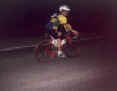 |
Pat
Dillon at speed
en route to Stovepipe |
Finally, the waking sun allowed us a glimpse of the horizon, and we welcomed the gradual
return of our frame of reference. Smooth, rolling macadam and a slight cross-tailwind
afforded us the luxury of effortless high speeds, and by the time the sun had commenced
its daily ritual of sand painting, we were leaning into Furnace Creek. There, we
relinquished our spent primary lighting systems, stuffed our jersey pockets with fuel, and
remounted, aiming our machines into the sun and toward the ancient, pitiless sentinels
which scowled at us, helmeted by the clouds.
The
approach to Badwater was even more rousing to us than that of Stovepipe Wells, largely due
to the bright sunlight and our renewed awareness of our surroundings. The black carpet of
asphalt, the only unnatural occurrence within view, unraveled before us, drawing our
machines toward Badwater with an almost foreboding ease. For most of the way, vertical
walls of rock to our left ushered our passage, as if deliberately shunting us toward the
waiting Titans that we would ultimately engage. To the right, though, was a vast stockade
of Giants which lorded over a seemingly interminable, featureless expanse of sand, borax,
and salt, and admonished us with the remnants of the lakes which had tried to upstage them
so long ago. But we were committed now. Brazenly, we pushed big gears toward Badwater.
It didn't
seem long, nor too terribly painful, before we found ourselves banking into the minor,
mildly curved descent to Badwater itself. It is as it sounds. The actual name of the
locale refers, most accurately, to an absolutely flat expanse of sand, salt, and choked
earth, nearly 300 feet below sea level, which is home to an inhospitable, brackish pool of
water which reshapes itself continually, contingent upon rainfall, and in which almost
nothing survives. On all sides, however, the Giants make themselves evident. Some were
within arm's reach, others were what seemed a half world across the desert, but they
seemed to oversee the flatland as if it were a vast arena of sorts, where some survivalist
drama would be played out. And, in fact, it was.
There was a
rest stop at Badwater and, by now, riders were thankful for the opportunity for some
social, as well as physical, sustenance. The cyclists' gregarious nature tended to
increase as darkness waned, it seemed, and among the pleasantries, there was no shortage
of banter about the infamous climbs that awaited us. It was common knowledge among the
tiny field of ultramarathoners that most of Death Valley's climbing occurs in the latter
hundred miles, but relatively fresh legs write checks freely, and everyone was operating
"in the black" as we rolled out of Badwater, southeast, toward the Giants.
|
It didn't take long before Pat and I were at speed again. Occasionally, we rode together,
two abreast, on roads which it seemed that we owned. And at other times, at whim, we would
join small pacelines, trading pull for draft, and formulating plans of attack for what lay
ahead. It was during those big-ring, marauding runs along the serpentine, flatland ribbon
that Pat and I entertained riders' questions about where we were from. The Thulman
Eastern/Chesapeake Wheelmen colors that I was flying prompted most of the queries, but
when our curious colleagues learned that we had flown our machines out here specifically
to look DV in the eye, they knew we wouldn't blink. And we never did. |
|
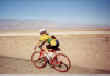
Pat pushing
big meat
out of Badwater |
|
|





.jpg)
.jpg)
.jpg)